

First impressions count since the reception area is frequently where customers connect with your business for the first time. A well-designed office welcome table conveys professionalism, brand identification, and corporate culture in addition to giving a receptionist a space to work. However, there is no one-size-fits-all approach to Office Reception Table Design. Compared to huge corporate headquarters, small offices have various functional requirements and space constraints. We'll look at ergonomic, aesthetically pleasing, and useful reception table design options for both small and large offices in this blog.
Why Office Reception Table Design Is Crucial
A reception table is a crucial workstation that establishes the tone for your entire company, and it is much more than just a surface for documents. Within the first few seconds of entering an office, visitors frequently make an impression, and their reception area has a significant impact on that assessment. A well-thought-out welcoming table improves visitor comfort and navigation while establishing credibility and trust. It enhances the productivity and efficiency of receptionists. The company's ideals and culture are reflected in the reception table. Additionally, it facilitates visitor control and security. On the other hand, a poorly designed reception table may come across as unkempt, unwelcoming, or out of date, which could have a detrimental effect on clients' perceptions even before any interaction starts.
Core Principles of Effective Reception Table Design
It's crucial to comprehend the basic ideas that underpin excellent office reception table design before deciding on a particular style or arrangement:
Functionality and Workflow
Daily tasks like answering calls, welcoming visitors, handling deliveries, setting up meetings, and keeping records must be supported by the reception table. Equipment placement, storage, and surface area must all be sufficient.
Visual Balance and Proportion
The receiving table's proportions and shape should match those of the lobby. While undersized tables may appear inconsequential in large offices, oversized tables can overpower small areas.
Alignment of Brands
The company's branding, whether corporate, creative, minimalist, or luxury-focused, should be reflected in the colors, finishes, materials, and general design language.
Ergonomics and Comfort
Receptionists frequently put in a lot of overtime. Comfort, productivity, and worker well-being are all directly impacted by ergonomic table height, legroom, and seating.
Reception Table Design for Small Offices
The goal of reception table design for small offices is to make the most of available space while preserving a polished and friendly appearance. The welcome space is kept orderly and aesthetically open with the use of compact designs with clean lines. Smart layouts, light colors, and simple design make small offices appear bigger and brighter. Essential goods are kept neatly stowed away thanks to built-in storage like shelves and drawers, which minimizes clutter. For longevity and contemporary style, materials like glass, laminate, and engineered wood are perfect. A welcoming table for a tiny office makes a good first impression without taking up too much room, thanks to its well-thought-out design and practicality. Here are some popular reception table designs:
Space-Efficient Desk Layouts
In compact offices, reception tables should occupy minimal floor space without compromising functionality. Some space-efficient designs, like straight reception tables, are ideal for narrow entrances and corridors. L-shaped reception tables utilize corners effectively and provide extra workspace. Wall-Mounted tables create a clean, modern look and free up floor area, making the space feel larger. Proper positioning ensures smooth movement for both visitors and staff.
Use of Light Colors and Reflective Surfaces
Light-colored finishes make tiny areas appear larger. White, beige, light wood, or pastel reception tables give the space a feeling of openness and spaciousness. Light is reflected via glass panels, glossy laminates, and acrylic components, giving the impression that the space is bigger and brighter. The visitor experience is improved, and spatial perception is enhanced when these materials are combined with adequate illumination.
Minimalist Design Approach
In small reception areas, minimalism is very effective. Visual overload can be prevented using simple shapes, clean lines, and a few decorative accents. A modest plant, subtle branding, and a simple reception table may create a polished yet welcoming space.
Reception Table Design for Large Offices
The goal of reception table design for large offices is to ensure seamless front desk operations while producing a powerful visual effect. Spacious reception tables with eye-catching designs, broad counters, and high-end finishes that convey corporate professionalism are advantageous for large offices. To effectively manage high visitor traffic, these tables frequently have plenty of storage, integrated technology, and multi-user functionality. Durability and elegance are added by materials like marble surfaces, veneer, glass, metal accents, and solid wood. A well-designed reception table makes a friendly yet authoritative first impression, boosts workflow, and promotes brand image. Large offices offer greater design freedom, allowing reception areas to become bold architectural statements:
Statement Reception Tables
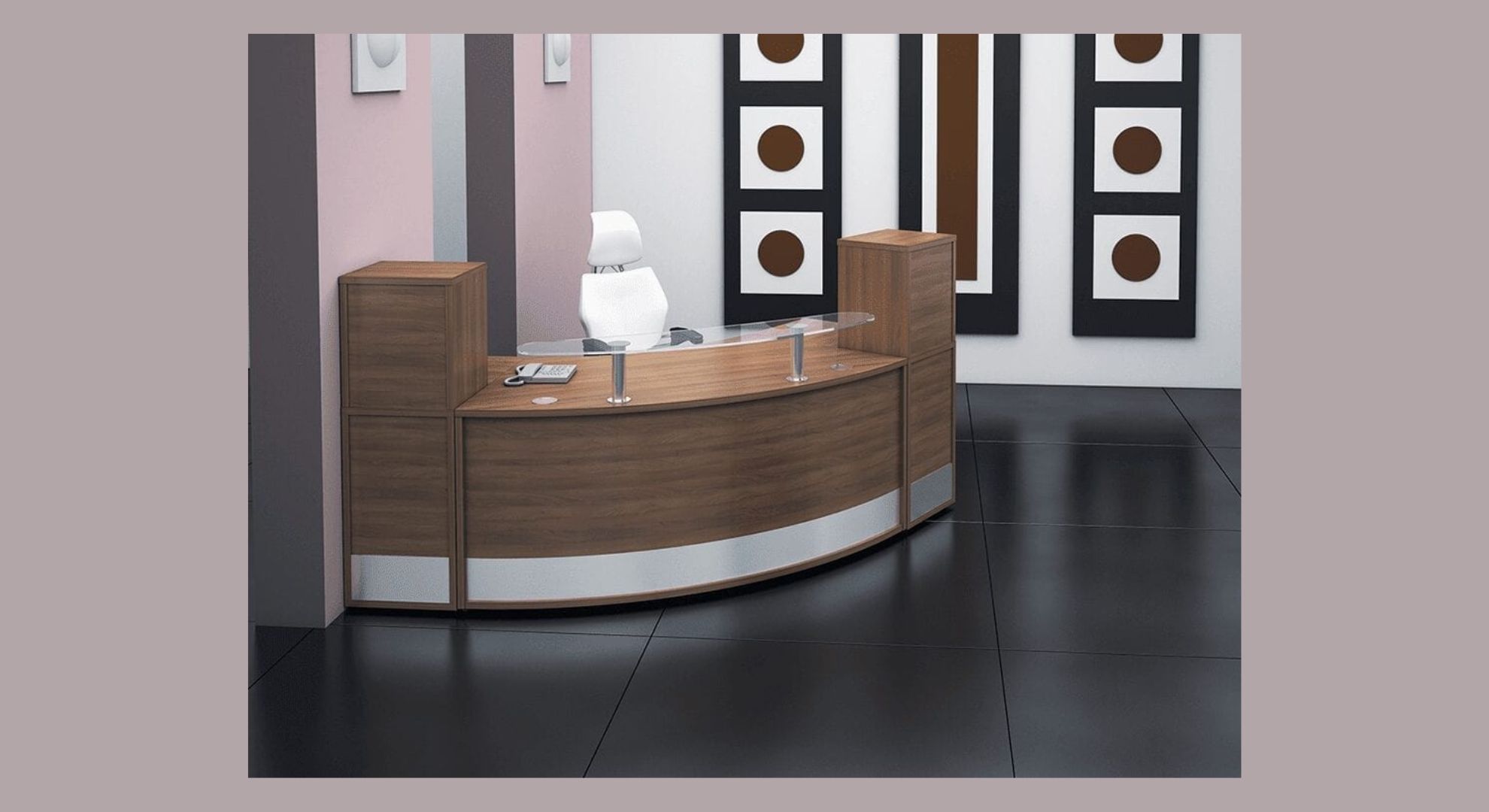
Attention-grabbing workstations that are curved, U-shaped, or specially designed might be placed in large reception areas. These designs increase the impression of scale and grandeur, facilitate better traffic flow, and offer enough workspace. These tables frequently serve as the lobby's focal point.
Multi-User Reception Desks
One receptionist might not be enough in busy offices. Multiple employees can operate concurrently at multi-station reception tables, which shortens wait times and increases visitor handling effectiveness. These tables are perfect for: Institutions, hospitals, corporate offices, , Co-working spaces, and Big business structures.
Seamless Integration with Waiting Areas
The waiting area and welcome table in large offices should have a visible connection. A unified and high-end appearance is produced by coordinated furniture types, complementary finishes, and uniform color schemes. Coffee tables, periodicals, charging stations, and cozy chairs improve the visitor experience and make waiting seem effortless.
Conclusion
The design of an office reception table design combines branding, ergonomics, utility, and beauty. Space efficiency, clever storage, and simple design should be the main priorities for small offices. Large offices prioritize enhanced functionality, brand messaging, and statement pieces. Not only does a well-designed reception table greet guests, but it also conveys professionalism, improves productivity, and fortifies your brand identity right away. Designing an office reception table involves more than simply furniture; it involves influencing a customer's initial impression of your company. Effective design decisions affect productivity, comfort, and brand perception, whether you're working with a little space or a large lobby.